
By Jared Hottle | Published: October 2026
384 farms. $10.2 million. Up 111% in five years.
That’s Iowa agritourism in the 2022 Census of Agriculture. Iowa farms reported $10,156,000 in income from agritourism and recreational services, up from $4,809,000 in 2017. The farm count only rose from 350 to 384, so the average farm nearly doubled its take, from $13,741 to $26,448 (USDA NASS). Nationally, 28,617 farms earned $1.26 billion, up 12.4% after inflation (USDA ERS).
Every pumpkin patch, orchard, haunted barn and farm stand is a bet that a few acres can earn more in seven weekends than corn and beans earn all year. Some of those bets pay. Zoning, tax class, liability, financing and exit decide whether they hold value. Here’s how fall works as a property business in Iowa, with the Cedar Valley up front. Plus one Iowa orchard that went metro and one Wisconsin apple town worth the drive.
Iowa Agritourism by the Numbers
- Agritourism income: $10.16 million on 384 farms in 2022, vs. $4.81 million on 350 farms in 2017.
- Food sold direct to consumers (farm stands, u-pick, farmers markets, CSAs): $30.1 million on 2,427 farms in 2022, up from $20.0 million on 2,575 farms. Fewer farms, 51% more dollars (NASS Table 2).
- Scale check: About $40 million combined, against $43.9 billion in total Iowa farm sales. A rounding error for the state. A big deal for a single farm.
- The neighbors (NASS U.S. table): Illinois $22.9 million, Wisconsin $20.8 million, Missouri $19.0 million, Nebraska $14.2 million, Minnesota $13.6 million. Iowa grew fastest of the six but still has the smallest total.
- Visitors: 46.1 million visitors spent $7.5 billion in Iowa in 2024. Entertainment and recreation was the fastest-growing category, up 5.2% to $1.24 billion. Day trips rose 4.5% while overnight stays fell 1.2% (Travel Iowa). Agritourism is a day-trip business.
- Black Hawk County: $278.8 million in 2024 visitor spending, down 3.3% (Travel Iowa county tables).

The Money Is Concentrated
Only 58 Iowa farms reported $25,000 or more in agritourism income in 2022. Together they earned $9.02 million, or 89% of the statewide total. By my math, that’s 15% of the farms collecting nearly nine of every ten dollars, at an average of about $155,000 each (NASS Table 7).
The state horticulture survey shows the same pattern. Fifty-six specialty-crop farms reported $6.6 million in agritourism income for 2022. The median was $7,150. The average was $118,200. The share of growers using a roadside stand jumped from 8% in 2015 to 25% in 2023, but the median stand did $886 in sales (IDALS/ISU Horticulture Survey, 2025).
A farm stand is a marketing channel. A destination farm is a real estate play.
The Cedar Valley Fall Map
Black Hawk County barely shows up in the Census. Just two farms reported agritourism income in 2022, and the dollars are withheld for privacy. Direct-to-consumer food sales were $833,000 across 62 farms, up 31% (NASS county Table 2). My read: the Census undercounts fall business here, because a lot of it gets reported as produce sales.
What’s actually on the ground:
- Heartland Farms, 5111 Osage Rd, Waterloo. Dave Myers started strawberries here in 1983 (Renewable Farming); the farm now sells from asparagus in May to pumpkins in October (ISU Visit Iowa Farms). The 2026 fall season runs Sept. 25 to Oct. 31 at $14 weekdays and $17 weekends, with a haunted barn and the PUNKINATOR pumpkin cannon (Experience Waterloo). Osage Road carries 480 vehicles a day (Iowa DOT, 2025). People don’t drive past it. They drive to it.
- Kiefer Farms, 4881 Texas St, Waterloo. It advertises “64 years of experience” with pumpkins, a haunted house and a hayride (Kiefer Farms). Nearby US 218 segments carry 7,900 to 10,600 vehicles a day (Iowa DOT, 2025).
- The Patch, 305 Roosevelt St, Cedar Falls. This is in-town seasonal retail (Living in Iowa). Highway 57 carries 15,900 vehicles a day at Roosevelt. (Iowa DOT, 2025)
- Hansen’s Farm Fresh Dairy, Hudson. It hosted nearly 9,000 tour visitors in 2022 and now runs a dedicated tour center (Hansen’s Dairy).
- Three Pines Farm, 9611 Wagner Rd, Cedar Falls. This farm hosts weddings and workshops around an 1866 barn. It changed hands in 2013 for the first time in 49 years (Three Pines Farm).
- Apples on the Avenue, Nashua. It bills itself as the Cedar Valley’s only u-pick orchard (Apples on the Avenue).
- Haunts. The Waterhawks Haunted Hayride at Eagle Lake in Evansdale ran seven nights at $15 in 2025 (Grow Cedar Valley). Waverly’s ran one night at the Bremer County Fairgrounds (City of Waverly, 2025).
For scale, look 60 miles south. Bloomsbury Farm in Atkins farms 1,700 acres of corn and soybeans. It added an 18-acre pumpkin patch and 270-plus part-time employees, and it expected up to 75,000 visitors in 2024 (Iowa Farm Bureau). The last Iowa DOT count on its road was 35 vehicles a day (2017).
Traffic counts matter for a farm stand. They barely matter for a destination.
Zoning: What Black Hawk County Allows
State law sets the floor. Under Iowa Code 335.2, county zoning doesn’t apply to land and farm buildings used primarily for agriculture (Iowa Code 335.2). Iowa Code 335.28 goes further. A county “shall not require a conditional use permit” for an “agricultural experience” on property whose primary use is ag production (Iowa Code 335.28).
Black Hawk County’s ordinance:
- “A” Agricultural: Orchards, truck gardens, Christmas tree farms and berries are permitted uses. Roadside stands selling products “produced on the premises” are an accessory use (BHCC 18.20).
- “A-L” Agricultural-Limited: Value-added processing and marketing, plus commercial recreational areas, need a Board of Adjustment permit (BHCC 18.25). The county scores requests with its LESA system. The fee is $125 (form), and the Board can’t approve unless all six standards are met (BOA minutes).
My read: a pumpkin patch on a working farm is well protected. The county gets a say once the use outgrows the farm: a wedding barn, a ticketed haunt, a restaurant. Inside Waterloo or Cedar Falls city limits, the 335 farm exemption doesn’t apply. Confirm with county Planning & Zoning (319-291-4366) before you price a deal on it.
Polk County shows the downside. Geisler Farms near Bondurant ran a pumpkin patch and event space under a 2009 conditional use permit. When the owners retired, staff wrote that the event space “may not continue as a standalone commercial use.” Selling 21 acres for an office campus took a rezoning, approved 3-2 in February 2023 against the zoning commission’s recommendation (Polk County staff report; KCCI).
Accessory rights die with the primary use. Price them that way.
Ag or Commercial? The Property Tax Line
Iowa classifies property by its present primary use. Land qualifies as agricultural when it’s farmed for intended profit, not actual profit (Iowa Department of Revenue memo), and ag land is valued on productivity rather than market value (Iowa Code 441.21).

The rollbacks widen the gap. For 2025, agricultural property is taxed on 59.4401% of value. Commercial property is taxed on 44.5345% of the first $150,000 and 90% of everything above that (IDR order).
If an assessor decides the event barn, not the corn, is the primary use, the tax basis moves from productivity value to market value. Model taxes both ways. “Zoned Ag” in a listing describes the zoning, not how the next assessor will classify the property.
Seven Weekends to Make a Year
Bloomsbury’s 2026 fall festival lists 23 operating days (tickets). Heartland’s fall run is 37 days. Center Grove Orchard in Cambridge stretches its season to 72 days on 20 acres (Center Grove).
One frost can wipe out the season. Big Apple Orchard in Mt. Vernon won’t open this fall after losing “about 90, 95%” of its crop. Owner Monte Marti called the season “like having an open house for seven weekends” (KCRG, Sept. 14, 2026).

The land sets the floor. Black Hawk County farmland averaged $13,455 an acre in the 2025 ISU survey (ISU CARD), and typical 2026 cash rent is $301 (ISU Extension). Whatever you pay above that is for buildings, permits and a crowd. Recent Iowa listings show how fragile that premium is. Quakerdale Farms in Hardin County was listed at $5.6 million for about 200 acres with houses, a campground and permits (Times-Citizen, Sept. 2025). The Epic Event Center in Marion was cut to $1.7 million (GLD Commercial). A Stratford barn winery went from $795,000 to $599,000, with seller financing offered (listing).
My underwriting checklist (analysis):
- Value the dirt and the business separately. Treat agritourism income as business value with its own risk.
- Stress-test one lost October. An annual debt-coverage ratio hides a season that never happens.
- Expect creative terms. Seller financing and price cuts are signs of a thin buyer pool.
- Reward longer calendars. Every extra operating month spreads the fixed costs.
Wilson’s Orchard: A Farm Brand Goes Metro
Wilson’s Orchard & Farm has operated since 1980 at 4823 Dingleberry Rd NE, about 5 miles northeast of downtown Iowa City. Paul Rasch and Sara Goering bought it in 2009 and grew it into a roughly 90-acre farm with u-pick apples, pumpkins, a bakery, cider, weddings and events (Little Village, July 2024). The AP reported about 100 apple varieties and about 265,000 visitors in 2021 across the orchard, market and restaurants (AP via KCRG, Oct. 15, 2022). The barn restaurant opened in 2017 and closed Dec. 29, 2024. Its upper level became a second private-event venue (The Gazette, Dec. 31, 2024), and the owners credited “lessons learned from our Des Moines Ciderhouse” (Corridor Business Journal).
Wilson’s calls its second site the “Des Moines Farm.” It’s at 3201 15th Ave. in Cumming, Warren County, about 10 minutes south of Des Moines on I-35 (Wilson’s). The timeline and numbers:
- Announced October 2022, ground broken November 2022, opened April 2024 with a tulip festival, then strawberry picking June 1 (AP; Little Village).
- About $7 million for a 22,000-square-foot event center, bakery, market and Ciderhouse built from reclaimed barn wood (Business Record, May 24, 2024).
- Acreage depends on the source: 115 at announcement (AP), 110 (Business Record), 125 “diversified acres” (Wilson’s site).
- City help: A November 2022 development agreement gave Fox Ridge Farms, LLC dba Wilson’s Orchard a $61,000 grant for a sewer extension and $75,000 for chip-sealing S. 15th Street (Cumming council packet, Apr. 14, 2025).
Site selection is the real story. Rasch spent a year looking near Des Moines for rolling hills, ponds and woods, and “mostly found flat cornfields.” It came together when the developer of Middlebrook, a 900-acre agrihood, added 160 acres to the project (AP). Business Record now pegs Middlebrook at $750 million and 800-plus acres, with 1,500 homes planned. General manager Jacob Goering put the trade-off plainly: “It’s not too metropolitan, but at the same time it’s close to a large consumer market. Those two factors are quite hard to find.”
I couldn’t find public reporting on whether Wilson’s bought or leases its Cumming ground, or at what price. Treat that as unknown.
My read: here the orchard plays the role a golf course plays in a subdivision. For a Cedar Valley farm brand thinking about a second site, the brand travels and the land basis doesn’t. The Iowa City restaurant closure shows a second site also changes the first.
Gays Mills, Wisconsin: The Driveable Benchmark
About 125 road miles northeast of Waterloo (my routing estimate), Gays Mills is what an orchard cluster looks like. Apple growing there dates to 1905, and the state horticulture society planted a five-acre trial orchard on High Ridge. The village claims “over a thousand acres of apple orchards” (Village of Gays Mills). The festival’s vendor listing puts it at about 1,500 acres around town (WECN, 2024). The village directory lists six orchard locations under four names: 1913 Kickapoo (East and West), Fleming, Sunrise (two sites) and Turkey Ridge Organic. 1913 Kickapoo alone advertises 118-plus varieties, a cider house, a cafe and a corn maze (1913 Kickapoo).


- The festival: It’s held the final full weekend of September, this year Sept. 25–27, with a parade, a carnival and markets at the fairgrounds (Apple Festival). The 2015 festival, the 57th, drew “nearly 10,000,” about twenty times the village population (WXOW/News8000, Sept. 28, 2015). A travel site claims 20,000-plus. I couldn’t confirm that.
- Orchards changing hands: Noel Miller and Harrison Heilman bought Kickapoo Orchard in 2023 and renamed it 1913 Kickapoo Orchard (1913 About). In 2024 the La Crosse Tribune reported new owners and names for two orchards, including Sunrise Orchards buying Hillcrest Orchard, with closing expected Oct. 1, 2024 (La Crosse Tribune, Sept. 6, 2024). I couldn’t find any sale prices.
- Land pricing: No orchard is publicly listed right now. The closest comp is 196 acres on Hwy 171 northwest of town, about 60 tillable and 130-plus timber, at $1,862,000. That’s about $9,500 an acre (MLS 2034433, accessed Oct. 16, 2026).
My read: the orchards sit on the ridges and the town sat in the valley. The farm economy stayed put, and the retail had to move to the highway with public money. The lesson for NE Iowa is clustering. Four operators plus a festival make one destination.
Haunts, Pop-Ups and Vacant Commercial Space
America Haunts estimates more than 1,200 paid haunted attractions in the U.S., with $300 million to $500 million in ticket sales. A typical attraction draws about 8,000 paid guests (America Haunts).
Iowa haunts move. Des Moines’ Slaughterhouse went from a 2009 pop-up to 97 Indiana Ave, then to the basement of 500 Locust St (CityView, 2019). Circle of Ash left a Cedar Rapids warehouse and reopened in 2016 at the Linn County Fairgrounds (Wikipedia). Iowa now enforces the 2024 International Fire Code (481 IAC 280.8), and America Haunts’ safety checklist includes sprinklers, smoke detection and panic hardware.
Retail pop-ups are the cleaner seasonal play. Spirit Halloween runs about 1,500 pop-ups (Fortune). It wants three-month leases, from mid-July to mid-November, with a kick-out clause, plus 35,000-plus residents within 3 to 5 miles and 25,000 cars a day (Spirit leasing). In Waterloo it’s in the former JoAnn at 1407 Flammang Dr (Spirit Waterloo). See my holiday pop-up lease guide, the fireworks stand post and my College Square post.
Key Takeaways for Property Professionals
- Growth is real, and concentrated. Iowa agritourism income rose 111% to $10.2 million, but 58 farms earned 89% of it.
- Land is the floor. At $13,455 an acre in Black Hawk County, price the agritourism premium separately.
- State law protects the patch, not the party. Iowa Code 335.28 bars a county CUP for agricultural experiences. Wedding barns, haunts and restaurants can still trigger review.
- Classification can flip. Ag property is taxed at 59.44% of productivity value. Commercial is taxed at up to 90% of market value.
- 673A needs the sign. And only half of specialty growers carry liability insurance.
- Farm brands can anchor metro development. Wilson’s put about $7 million into a building inside a $750 million agrihood.
- Clusters beat lone operators. Gays Mills turned more than 1,000 acres of orchards and one festival weekend into a regional draw.
- Pop-ups want 25,000 cars a day. Destinations don’t. See my drive-thru site guide and the Q3 2026 market report.
Buying, leasing or repositioning a farm venue, seasonal lot or vacant building in the Cedar Valley? I’ll pull the zoning, traffic and tax picture first.
Sources
- USDA NASS, 2022 Census of Agriculture, Iowa Table 7: Income from Farm-Related Sources, 2022 and 2017 (Feb. 2024)
- USDA NASS, 2022 Census, Iowa Table 2: Market Value incl. Food Marketing Practices (Feb. 2024)
- USDA NASS, 2022 Census, U.S. State-Level Table 6 (Feb. 2024)
- USDA NASS, 2022 Census, Iowa County Table 2 (Feb. 2024)
- USDA ERS, “The majority of U.S. counties generate some agritourism income” (Dec. 5, 2024)
- IDALS/ISU, Results of the Iowa Commercial Horticulture Food Crops Survey (summer 2025)
- ISU CARD, Comparative Iowa Land Values 2024–2025 (Dec. 2025)
- ISU Extension, Cash Rental Rates for Iowa 2026 Survey (May 2026)
- Travel Iowa, 2024 Economic Impact of Tourism (Oct. 2025) and 2024 County Tables
- Iowa Code 673A (2026 Code); Iowa Code 335.2; Iowa Code 335.28; Iowa Code 441.21 (accessed Oct. 16, 2026)
- Black Hawk County Code 18.20, 18.25, Special Permit form, BOA minutes (June 26, 2018) (accessed Oct. 16, 2026)
- Polk County Zoning Commission, Geisler Farms staff report (Nov. 28, 2022); KCCI (Feb. 7, 2023)
- Iowa Department of Revenue, Agricultural Classification memo (Apr. 26, 2017); 2025 rollback order
- Iowa Admin. Code 481—Ch. 280, State Fire Code (IAC Sept. 30, 2026)
- Iowa DOT RAMS Traffic Information (AADT) layer (queried Oct. 16, 2026)
- Iowa Farm Bureau, Bloomsbury Farm feature (Oct. 14, 2024); Bloomsbury 2026 tickets
- Experience Waterloo, BeautiFALL Waterloo (2026); ISU Visit Iowa Farms: Heartland Farms; Renewable Farming: Heartland Farms profile (undated)
- Kiefer Farms (accessed Oct. 16, 2026); Living in Iowa (updated Oct. 13, 2026); Hansen’s Dairy (Sept. 26, 2023); Three Pines Farm; Apples on the Avenue
- Grow Cedar Valley, Waterhawks Haunted Hayride (Oct. 2025); City of Waverly, Haunted Hayride (Oct. 25, 2025)
- Times-Citizen, Quakerdale Farms listed for sale (Sept. 5, 2025); GLD Commercial, Epic Event Center (May 28, 2026); 3533 Fenton Ave, Stratford listing (accessed Oct. 16, 2026)
- Center Grove Orchard (2026 season); KCRG, Big Apple Orchard (Sept. 14, 2026)
- America Haunts, Facts (accessed Oct. 16, 2026); CityView, Slaughterhouse (Oct. 2, 2019); Wikipedia, Circle of Ash
- Spirit Halloween real estate criteria; Spirit Halloween Waterloo; Fortune/Morning Brew (Oct. 27, 2025)
- Little Village, Wilson’s Orchard and Farm in Cumming (July 15, 2024); AP via KCRG, Iowa City family opening 2nd farm business near Des Moines (Oct. 15, 2022); Business Record, Commercial development begins in Middlebrook Agrihood (May 24, 2024); Wilson’s Orchard, Des Moines Farm (accessed Oct. 16, 2026)
- The Gazette, Wilson’s Ciderhouse closes its Iowa City restaurant (Dec. 31, 2024); Corridor Business Journal, Wilson’s Orchard announces restaurant closure (Jan. 2025); City of Cumming council packet, Apr. 14, 2025
- Village of Gays Mills, Apple Orchards (accessed Oct. 16, 2026); Village of Gays Mills, Apple Festival 2026; WECN, Gays Mills Apple Festival listing (2024); WXOW/News8000 (Sept. 28, 2015)
- 1913 Kickapoo Orchard home and About Us (accessed Oct. 16, 2026); La Crosse Tribune, Gays Mills apple orchards get new names, owners (Sept. 6, 2024); 196 acres Hwy 171, Gays Mills, MLS 2034433 (accessed Oct. 16, 2026)
- FEMA Long-Term Community Recovery Plan, Gays Mills (Nov. 2008); WisBusiness, flood relief funding (Mar. 10, 2010); WisBusiness, Gays Mills rises from flood waters (Oct. 31, 2011)
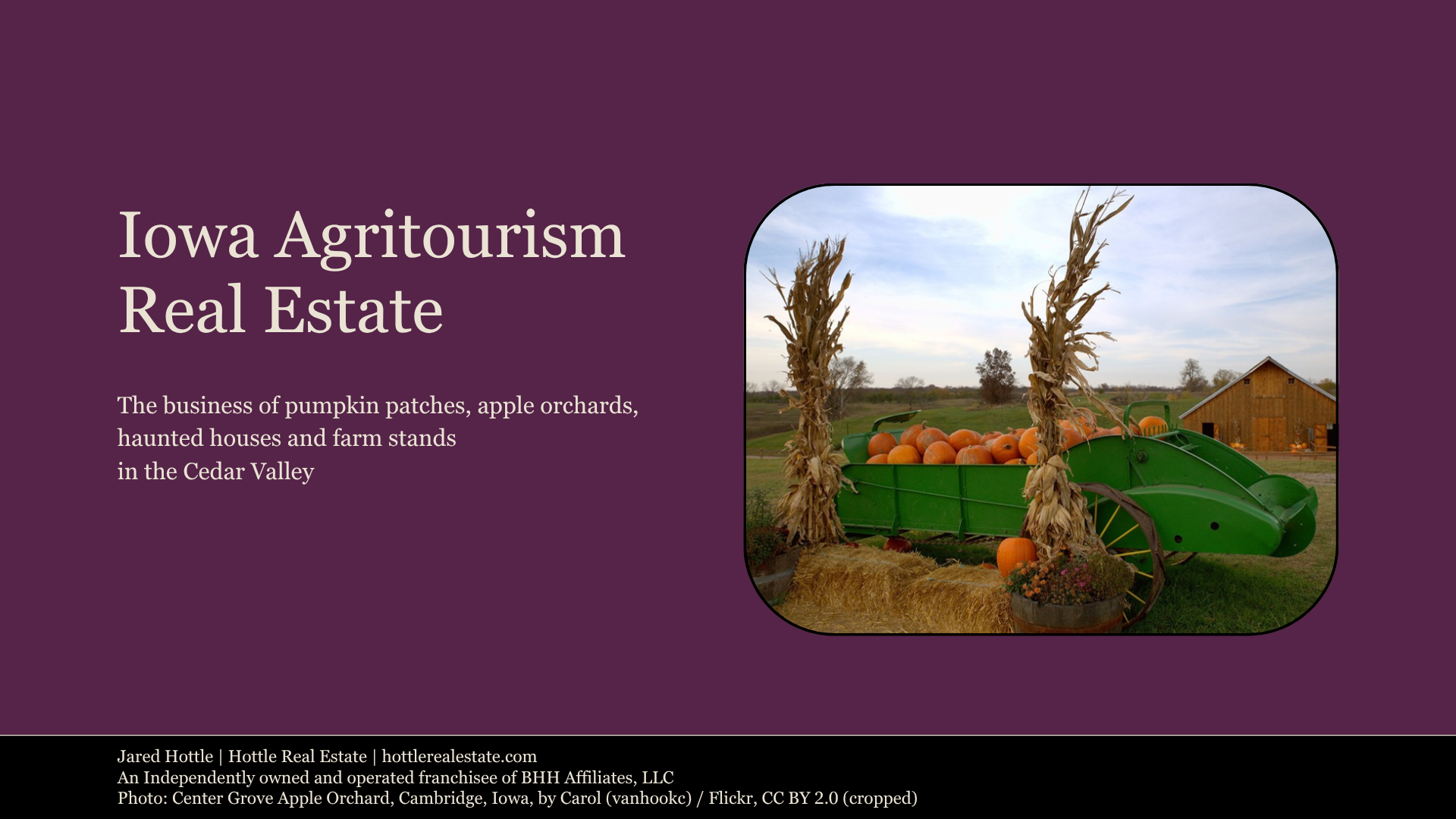
- Photo credit, featured image: Center Grove Apple Orchard, Cambridge, Iowa, by Carol (vanhookc) / Flickr, CC BY 2.0 (cropped, Oct. 27, 2014)
- Photo credit: Pierce’s Pumpkin Patch, 2014 Farm Crawl, Iowa, by Phil Roeder / Flickr, CC BY 2.0 (cropped, Oct. 5, 2014)
- Photo credit: Red barn at an apple orchard east of Cambridge, Iowa, by cwwycoff1 / Flickr, CC BY 2.0 (cropped, Sept. 1, 2010)
- Photo credit: Apple orchard in rural Weldon, Iowa, by USDA NRCS Iowa / Flickr, public domain (Sept. 14, 2018)
- Photo credit: Fleming Orchards near Gays Mills, Wisconsin, by Corey Coyle / Wikimedia Commons, CC BY 3.0 (cropped, Oct. 3, 2014)