Street Trees Are Economic Infrastructure: Why Canopy Cover Drives Retail Sales, Property Values, and Downtown Vitality
By Jared Hottle | Published: 2026-02-24
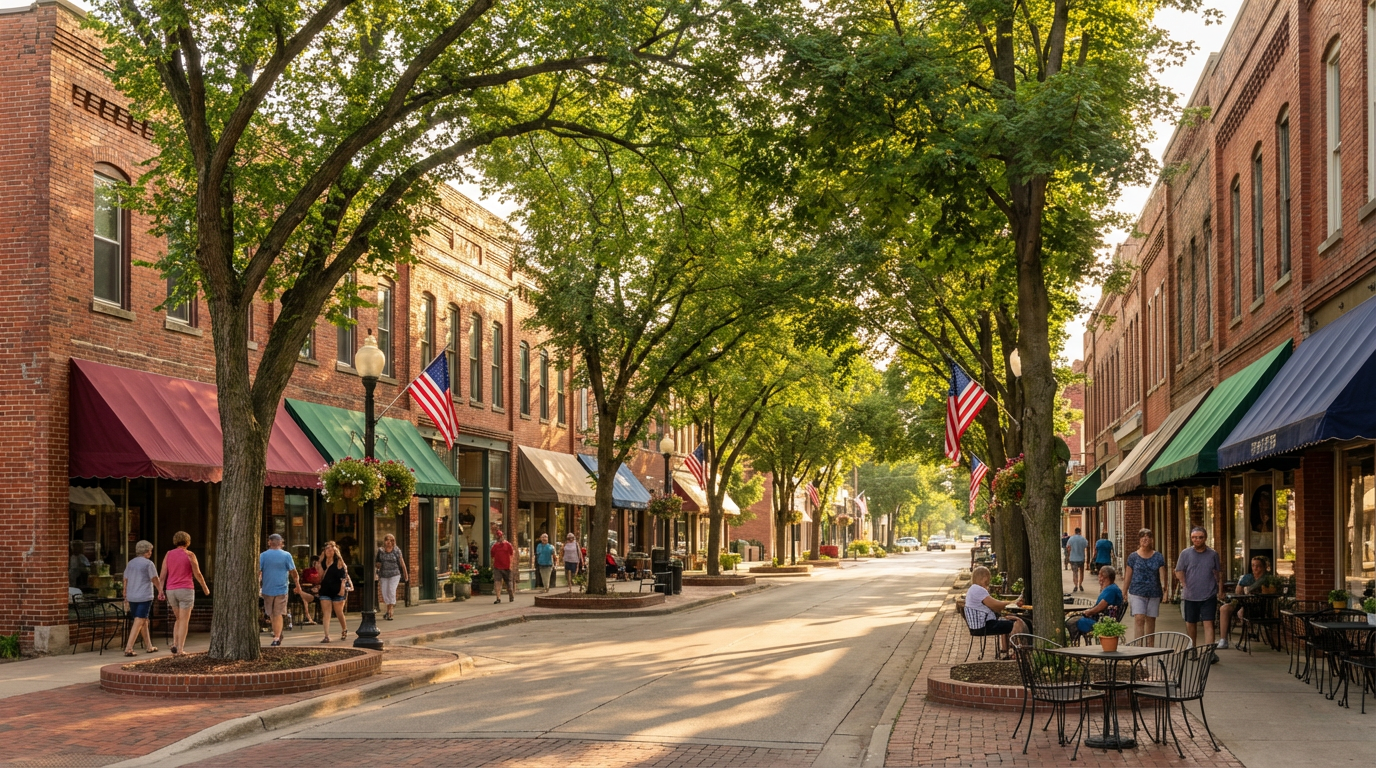
Street Trees Are Economic Infrastructure: Why Canopy Cover Drives Retail Sales, Property Values, and Downtown Vitality
Shoppers spend 9 to 12 percent more for goods and services in business districts with large, well-maintained street trees. Commercial properties with quality landscaping command roughly 7 percent higher rental rates than comparable properties without them. Well-planned streetscape improvements—including trees—have been linked to commercial trade increases of up to 40 percent in some downtowns. And tree shade can extend the functional lifespan of asphalt pavement by up to 60 percent.
These are not feel-good statistics. They are bottom-line numbers pulled from peer-reviewed research spanning two decades, and they point to a conclusion that city planners, commercial property owners, and downtown business operators should take seriously: street trees are economic infrastructure, not decoration. In the Cedar Valley and across the Midwest, where downtowns compete with suburban corridors, e-commerce, and regional malls for every dollar of consumer spending, the tree canopy overhead is quietly shaping where people shop, how long they stay, and what they are willing to pay.
The Retail Revenue Case: 9 to 12 Percent More Per Transaction
Dr. Kathleen Wolf, a research social scientist at the University of Washington, has spent more than two decades studying how urban trees affect consumer behavior. Her multi-study research program—published in the Journal of Forestry and the Journal of Arboriculture—found that consumers in retail districts with mature, healthy canopy are willing to pay 9 to 12 percent more for equivalent goods and services compared to identical products in treeless shopping environments (Wolf, 2005, Journal of Forestry 103(8):396-400).
That premium is not trivial. For a downtown shop averaging $500,000 in annual revenue, a 10 percent lift translates to $50,000 in additional sales—from the same customers buying the same products—simply because the streetscape environment shifted their perception of product quality, merchant credibility, and district character.
Wolf's research also found that shoppers claim they will travel farther, visit more often, and stay longer in retail districts with healthy tree canopy. For any downtown trying to expand its trade area radius, that behavioral shift adds thousands of potential customers from surrounding neighborhoods and communities. In the Cedar Valley, where Waterloo and Cedar Falls downtowns serve a combined metro population of roughly 170,000, expanding the effective catchment area by even a few miles means reaching shoppers who might otherwise default to a strip mall or an Amazon order.
The Property Value Multiplier: $8,870 Per Home and 7 Percent Higher Commercial Rents
The economic case extends well beyond the cash register. Geoffrey Donovan and David Butry of the USDA Forest Service Pacific Northwest Research Station published a landmark hedonic valuation study in Landscape and Urban Planning (2010) examining every home sale in Portland, Oregon, against the city's street tree inventory. Their findings: street trees added an average of $8,870 to each home's sale price and reduced time on market by 1.7 days (Donovan & Butry, 2010).
Applied citywide, that tree premium generated an aggregate home value increase of $1.35 billion and an estimated $13 million to $15.3 million in additional annual property tax revenue for the City of Portland (USDA Forest Service). The trees effectively paid for their own planting and maintenance—many times over—through the tax base alone.
On the commercial side, Laverne and Winson-Geideman (2003) found that office buildings with high-quality landscaping, including mature trees, commanded roughly 7 percent higher rental rates than comparable properties without them (Journal of Arboriculture). For a 10,000-square-foot office lease at $12.00 per square foot, that 7 percent premium represents an additional $8,400 per year flowing to the property owner. Multiply that across a downtown corridor of 20 commercial buildings and the aggregate rent premium alone justifies significant public investment in tree planting and maintenance infrastructure.
The Temperature Equation: Cooler Streets Mean More Foot Traffic
The mechanism behind these economic effects is partly psychological—people perceive treed districts as better maintained and higher quality—but it is also deeply physical. Street trees reduce ambient air temperatures through shade and evapotranspiration, directly mitigating the urban heat island effect that makes unshaded pavement and parking lots measurably hotter than surrounding areas.
Research published in Proceedings of the National Academy of Sciences (PNAS) in 2019, based on bicycle-mounted sensor data collected across Madison, Wisconsin—a Midwest city with climate patterns comparable to Iowa's Cedar Valley—found that air temperature decreased nonlinearly with increasing canopy cover, with the greatest cooling occurring when canopy cover exceeded 40 percent. At that threshold, daytime temperature variability within the urban landscape averaged 3.5°C (approximately 6.3°F) between high-canopy and low-canopy areas (Ziter et al., PNAS, 2019).
A 2024 study published in Heliyon, using bike-mounted temperature sensors in Baltimore, Maryland, found that tree canopy provided cooling of 1.62°C (approximately 2.9°F) during clear midday conditions, with the effect intensifying to 1.78°C (3.2°F) during the hottest afternoons (ScienceDirect, 2024).
A November 2025 study in npj Urban Sustainability found that a spatially optimized 10 percent increase in tree canopy in urban hotspots can reduce average temperatures by 0.8°C (1.4°F), while a 30 percent increase in canopy coverage can yield cooling benefits of up to 8.2°C (14.8°F) in the best-case scenario (Nature, 2025).
For a downtown business district, the implication is straightforward: cooler sidewalks keep people walking instead of retreating to air-conditioned cars. More pedestrians mean more window-shopping, more impulse stops, more dwell time per block—exactly the "park once, visit three stores" pattern that every main street merchant wants.
The Infrastructure Savings: Pavement, Energy, and Stormwater
Street trees do not just generate revenue. They reduce municipal costs across multiple budget line items simultaneously—a feature that makes them one of the most efficient infrastructure investments a city can make.
Pavement longevity. Research by Dr. E. Gregory McPherson of the USDA Forest Service Center for Urban Forest Research found that tree shade can improve the lifespan of street surfaces by up to 60 percent by reducing temperature fluctuations that cause asphalt expansion and contraction, the primary driver of surface cracking (Journal of Arboriculture, 2005). For a Midwest city resurfacing streets on a 15-to-20-year cycle, extending pavement life by even a third represents millions of dollars in deferred capital costs over a decade.
Building energy costs. Trees shading building facades and roofs can reduce air-conditioning energy use by 20 to 30 percent in some configurations. The USDA Forest Service estimates that trees in American urban and community areas reduce residential energy use by an average of 7.2 percent, translating to a national savings of $7.8 billion per year (Strong Towns, 2024). For downtown commercial buildings running HVAC systems through Iowa's increasingly hot summers, shaded facades and parking areas translate directly to lower operating costs for tenants and property owners.
Stormwater management. Trees absorb approximately 30 percent of precipitation through their leaves and capture another 30 percent through canopy interception before it reaches the ground. New York City's urban forest removes an estimated 1,821 metric tons of air pollution annually, valued at $9.5 million in avoided health and environmental costs. Sacramento's 6 million urban trees save the county roughly $19.8 million per year in energy costs and another $28.7 million in air pollution removal (TreeNet).
In a single line item, a strategic tree planting program addresses heat mitigation, stormwater capacity, air quality, pavement maintenance, and energy costs—five capital projects collapsed into one.
The Amazon-Proof Advantage: What E-Commerce Cannot Replicate
Physical retail in 2026 competes on experience, not just transaction speed. Consumers who visit brick-and-mortar stores are increasingly doing so for reasons that have nothing to do with the product itself—they want to browse, discover, socialize, and enjoy the environment. Wolf's research consistently found that visual preference scores are significantly higher for shopping streets with mature canopy than for streets without trees, even when building quality and sidewalk tidiness were identical (University of Washington, Green Cities: Good Health).
A shaded, attractive sidewalk with a continuous canopy is one of the few competitive advantages that a downtown merchant has over a fulfillment warehouse. Amazon cannot ship a tree-lined streetscape. The experiential quality of walking under a mature elm canopy on a July afternoon, stopping at a café with outdoor seating beneath dappled shade, and browsing a storefront with natural light filtering through leaves—that is a product that only the physical built environment can deliver.
Research on retail streetscapes also finds that people perceive blocks with continuous canopy as shorter and are willing to walk farther and visit more stores when mature trees are present. That perception effect directly supports the core retail strategy of every viable downtown: keep people on their feet, moving from store to store, extending dwell time, and increasing the probability of an additional purchase at each stop.
The Virtuous Cycle: Trees, People, Sales, and Reinvestment
The economic case for street trees is not a collection of isolated statistics. It describes a self-reinforcing cycle—a flywheel—that compounds over time.
Cooler, greener streets attract more pedestrians. More foot traffic supports more small businesses. More active storefronts generate higher sales tax and property tax revenue. Higher revenue justifies further streetscape investment, including better tree pits, adequate soil volumes, and proper irrigation—the infrastructure that produces healthier canopies with larger crowns and longer lifespans. Those healthier canopies, in turn, provide more shade, higher visual quality, and stronger economic effects, which attract more pedestrians and restart the cycle at a higher level.
Conversely, the opposite cycle is equally real. Remove the canopy—or allow it to decline through neglect, poor soil conditions, and undersized tree pits—and foot traffic drops, retail vacancies increase, property values soften, tax revenue declines, and the budget for streetscape maintenance shrinks further. Iowa saw this dynamic accelerate in Cedar Rapids after the August 10, 2020 derecho destroyed approximately 65 percent of the city's tree canopy in a single hour. The city's response—ReLeaf Cedar Rapids, a collaboration between the City, nonprofit Trees Forever, landscape architects Confluence, and planner Jeff Speck of Speck & Associates—committed $1 million per year and a plan to replant 42,000 street and park trees over a decade (Congress for the New Urbanism, 2023). That investment was not sentimental. It was economic infrastructure recovery.
The Cedar Valley Context: Tree City USA and the Opportunity Ahead
Both Waterloo and Cedar Falls hold Tree City USA designations from the Arbor Day Foundation, a recognition that requires minimum standards for tree care ordinances, community forestry programs, annual per-capita spending on urban forestry, and Arbor Day observance. The Iowa DNR's Urban Forestry Grant Programs currently offer competitive, non-match grant funding between $10,000 and $50,000 per applicant through the USDA Forest Service Inflation Reduction Act for projects including community forestry plans, educational programming, and workforce development (Iowa DNR).
Waterloo Leisure Services maintains approximately 17,000 street trees across the city's right-of-way, parks, and golf courses (Waterloo Leisure Services). The Iowa Urban Tree Council has recognized the Trees for Cedar Valley program for outstanding youth engagement in urban forestry (Iowa DNR).
The infrastructure is in place. The grant funding is available. The research is unambiguous. For commercial property owners, downtown merchants, and municipal planners in the Cedar Valley, the question is no longer whether street trees matter economically. The question is whether the current canopy is being managed as the revenue-generating infrastructure asset that the data says it is—or whether it is still being treated as an afterthought.
Plant Waterloo: $20 Trees Available Now for Spring 2026
The City of Waterloo is making this investment accessible right now. The Plant Waterloo spring 2026 residential tree program—funded by a generous donation from The Young Family Foundation—allows Waterloo residents to purchase one or two trees for just $20 each. Nine species are available, including large canopy shade trees like Bur Oak (80 feet tall and 80 feet wide at maturity), Honeylocust (70 by 70 feet), Tuliptree (90 by 50 feet), Red Maple (60 by 45 feet), American Linden (60 by 35 feet), and Baldcypress (70 by 30 feet), along with smaller ornamental options like Snowdrift Crabapple and Chokecherry.
Trees must be picked up on Thursday, May 7, 2026, from 4:00 to 5:30 p.m. at 1101 Campbell Avenue in Waterloo. Advanced purchase is required and limited to two trees per household to ensure broad participation. Order forms are available at the Waterloo Leisure Services office at the same address during normal business hours, or by calling (319) 291-4370. Orders placed after April 17, 2026, should call ahead to confirm availability—trees sell out quickly (City of Waterloo — Plant Waterloo).
For maximum energy efficiency, the City recommends planting shade trees within 30 feet of the east and west sides of a home and conifers as windbreaks along the north and west sides. Iowa law requires calling 811 at least two business days before digging.
At $20 per tree, this is one of the highest-return investments a homeowner or property owner in Waterloo can make. A single mature shade tree can add thousands of dollars to a property's assessed value, reduce cooling costs by double-digit percentages, and contribute to the neighborhood-level canopy cover that drives all the economic effects outlined above. Two trees for $40 is less than a dinner out—and the return compounds every year for decades.
Key Takeaways for Property Professionals
Retail revenue. Shoppers spend 9 to 12 percent more in districts with mature street trees, and well-planned streetscape improvements have been linked to commercial trade increases of up to 40 percent (Wolf, 2005; Association of Town Centre Management, 2007).
Property values. Street trees add an average of $8,870 per home in Portland, Oregon, generating $13 million to $15.3 million in annual property tax revenue citywide (Donovan & Butry, 2010). Commercial properties with quality landscaping see roughly 7 percent higher rents (Laverne & Winson-Geideman, 2003).
Temperature reduction. Canopy cover exceeding 40 percent produces the greatest cooling effect, with air temperatures 3.5°C (6.3°F) lower than low-canopy areas in Midwest conditions (Ziter et al., PNAS, 2019).
Infrastructure savings. Tree shade extends asphalt pavement life by up to 60 percent (McPherson, 2005). Urban trees reduce residential energy use by 7.2 percent nationally, saving $7.8 billion per year (USDA Forest Service).
Grant funding. The Iowa DNR offers $10,000 to $50,000 in non-match urban forestry grants through the Inflation Reduction Act for community tree projects (Iowa DNR, 2025).
Plant Waterloo. The City of Waterloo's spring 2026 residential tree program offers trees at $20 each (limit two per household), funded by The Young Family Foundation. Nine species available including large canopy shade trees. Pickup May 7, 2026. Order at (319) 291-4370 or at the Leisure Services office, 1101 Campbell Avenue.
Competitive advantage. Tree-lined streetscapes are the one retail amenity that e-commerce cannot replicate. In a market where physical retail competes on experience, canopy cover is a differentiator.
For more property guides and real estate insights in Northeast Iowa, explore our comprehensive Property Guides section.
Sources
- Wolf, K.L. (2005). "Business District Streetscapes, Trees and Consumer Response." Journal of Forestry 103(8):396-400
- Donovan, G.H. & Butry, D.T. (2010). "Trees in the City: Valuing Street Trees in Portland, Oregon." Landscape and Urban Planning
- USDA Forest Service Pacific Northwest Research Station — Portland Street Tree Value Study
- Ziter, C.D. et al. (2019). "Scale-dependent interactions between tree canopy cover and impervious surfaces reduce daytime urban heat during summer." PNAS
- Heliyon (2024). "Variation in the relationship between urban tree canopy and air temperature reduction under a range of daily weather conditions."
- npj Urban Sustainability (2025). "Increasing tree canopy lowers urban air temperature by up to 1.5°C in heat-prone areas."
- McPherson, G. & Muchnick, J. (2005). "Effects of Street Tree Shade on Asphalt and Concrete Pavement Performance." Journal of Arboriculture 31(6):303-310
- Durand-Wood, E. (2024). "The Multitasking Marvel: How Street Trees Can Solve Many Municipal Problems." Strong Towns
- University of Washington — Green Cities: Good Health — Local Economics
- Iowa DNR — Urban Forestry Grant Programs
- Waterloo Leisure Services — Forestry Services
- Congress for the New Urbanism (2023). "Citywide Forestry Plan Sets a New Urban Standard" — ReLeaf Cedar Rapids
- City of Waterloo — Plant Waterloo Spring 2026 Residential Tree Program